

California domestic violence laws cover physical and nonphysical abuse in qualifying relationships, including threats, harassment, stalking, and coercive control. These cases can lead to criminal charges, restraining orders, firearm restrictions, and child custody consequences.
What Qualifies as Domestic Violence in California?
California’s Domestic Violence Prevention Act defines “abuse” broadly. Under Family Code Section 6203, abuse includes intentionally or recklessly causing or attempting to cause bodily injury, sexual assault, placing someone in reasonable fear of imminent serious bodily injury, and behavior that can be prohibited under Family Code Section 6320. The statute specifically states that abuse is not limited to actual physical injury or assault.
This distinction matters because a person does not necessarily need bruises, broken bones, or another visible injury to seek protection.
Family Code Section 6320 allows courts to restrain conduct such as:
- Attacking, striking, or battering
- Threatening or stalking
- Harassing or repeatedly contacting someone
- Destroying personal property
- Sexually assaulting someone
- Coming within a specified distance of another person
- Disturbing another person’s peace
- Certain forms of impersonation
- Coercive control
California law defines “disturbing the peace” as conduct that, considering the circumstances as a whole, destroys another person’s mental or emotional calm. The statute also recognizes coercive control, including unreasonable isolation from family or friends, deprivation of basic necessities, monitoring communications or movements, controlling finances, threats involving immigration status, and reproductive coercion.
For example, repeatedly monitoring a partner’s location, taking control of all access to money, isolating the partner from relatives, and using threats to control daily decisions may potentially support a domestic violence restraining order even when no physical assault occurred.
Who Is Covered by California Domestic Violence Laws?
Domestic violence protections do not apply to every dispute between two people. The relationship between the parties generally must fall within categories established by California law.
Family Code Section 6211 includes abuse committed against:
- A current or former spouse
- A current or former cohabitant
- Someone with whom the accused person currently has or previously had a dating or engagement relationship
- Someone with whom the accused person shares a child
- A child of one of the parties in specified circumstances
- Certain relatives related by blood or marriage within the second degree
This means domestic violence laws can apply even if the parties never married.
Former dating partners can also qualify. California Penal Code Section 243 defines a dating relationship as frequent, intimate associations primarily characterized by an expectation of affectional or sexual involvement.
A dispute involving someone outside these covered relationships may still violate assault, battery, stalking, harassment, or other laws, but a different type of restraining order could apply.
Common Domestic Violence Criminal Charges in California
There is no single criminal offense called simply “domestic violence.” Instead, prosecutors may file different charges depending on the alleged behavior, injuries, relationship, prior convictions, and other circumstances.
Two commonly encountered charges are corporal injury under Penal Code Section 273.5 and domestic battery under Penal Code Section 243(e)(1).
| California offense | Basic conduct | Potential statutory punishment |
| Corporal injury, Penal Code § 273.5 | Willfully causing an injury resulting in a traumatic condition to a qualifying intimate partner | State prison for 2, 3, or 4 years, or county jail for up to 1 year, and/or a fine up to $6,000 |
| Domestic battery, Penal Code § 243(e)(1) | Battery against a spouse, cohabitant, co-parent, former spouse, fiancé(e), or current/former dating partner | County jail for up to 1 year and/or a fine up to $2,000 |
Actual sentences depend on the charge, criminal history, facts of the case, enhancements, plea negotiations, and judicial decisions.
Corporal Injury Under Penal Code Section 273.5
Penal Code Section 273.5 applies when someone willfully inflicts corporal injury resulting in a “traumatic condition” upon a qualifying intimate partner.
A traumatic condition may include a wound or other external or internal bodily injury. The statute expressly includes injuries resulting from strangulation or suffocation and recognizes injuries of either a minor or serious nature.
The offense is classified as a felony by statute, although the section allows punishment either in state prison or county jail depending on how the case is handled. Prior specified convictions can increase potential penalties.
Domestic Battery Under Penal Code Section 243(e)(1)
Domestic battery does not require proof of the type of traumatic injury required by Section 273.5.
Penal Code Section 243(e)(1) applies when battery is committed against specified intimate partners, including spouses, cohabitants, co-parents, former spouses, fiancé(e)s, and current or former dating partners. The maximum statutory punishment includes up to one year in county jail and a fine of up to $2,000.
If probation is granted, the statute generally requires participation in and successful completion of a batterer’s treatment program lasting at least one year.
Other conduct associated with domestic violence can potentially result in charges involving criminal threats, stalking, vandalism, sexual offenses, false imprisonment, child abuse, or violations of protective orders.
Domestic Violence Restraining Orders in California
A domestic violence restraining order, commonly called a DVRO, is a civil court order intended to protect someone from abuse by a person with whom they have a qualifying relationship.
A DVRO can potentially order the restrained person to stop contacting or approaching the protected person, move out of a shared residence, stay away from specified locations, surrender firearms, follow child custody orders, or comply with other protections authorized by law.
California Courts states that there is no court filing fee to request a domestic violence restraining order, and a person does not have to hire an attorney to apply.
The basic process generally works as follows:
- The person seeking protection completes and files the required forms.
- A judge considers whether temporary protection should be granted.
- Court papers are served on the other person.
- The restrained person has an opportunity to respond.
- The parties attend a court hearing.
- The judge decides whether a longer-term order should be issued.
The primary request form is DV-100, Request for Domestic Violence Restraining Order. California Courts advises applicants to describe specific facts about the abuse and generally place the most recent incident first.
How Quickly Can Someone Get Temporary Protection?
A person who believes protection is needed immediately can request a temporary restraining order, or TRO.
According to California Courts, after the required forms are submitted, a judge generally makes a decision regarding temporary protection the same day or by the next business day.
The temporary order may remain in effect while the case proceeds toward a hearing. The person accused of abuse must comply with any order that has been issued and properly served or otherwise legally communicated as required.
A final domestic violence restraining order issued after a hearing can last up to five years and may later be renewed.
A civil DVRO is also separate from a criminal protective order. Someone may have a criminal protective order connected to a criminal prosecution while also seeking a domestic violence restraining order in family court. California Courts notes that a civil DVRO can provide protections, including certain custody-related relief, that a criminal order might not include.
Firearm Restrictions After a Protective Order
California domestic violence protective orders can have immediate consequences for firearm and ammunition possession.
Family Code Section 6389 provides that a person subject to a qualifying protective order may not own, possess, purchase, or receive firearms or ammunition while the order remains effective. Violations may result in criminal punishment under the Penal Code.
These restrictions can apply even to temporary restraining orders. California Courts’ DVRO materials instruct restrained persons to comply with firearm and ammunition orders and provide forms for documenting that firearms were turned in, sold, or stored as required.
Anyone subject to such an order should carefully read every provision rather than assuming the restrictions begin only after a final hearing.
How Domestic Violence Can Affect Child Custody
Domestic violence can substantially affect California child custody decisions.
Under Family Code Section 3044, when a court finds that a parent seeking custody committed domestic violence within the previous five years against certain protected persons, a rebuttable presumption arises that awarding that person sole or joint physical or legal custody would be detrimental to the child’s best interests.
“Rebuttable” means the outcome is not automatic. The parent can attempt to overcome the presumption, but the court must evaluate statutory factors.
Those factors can include whether the person completed an appropriate batterer’s treatment program, complied with probation or parole, followed restraining orders, completed relevant substance-abuse treatment or parenting classes, and committed additional domestic violence.
A domestic violence finding therefore can affect family-law proceedings even when custody, rather than criminal punishment, is the primary dispute.
Civil Domestic Violence Cases and Criminal Cases Are Different
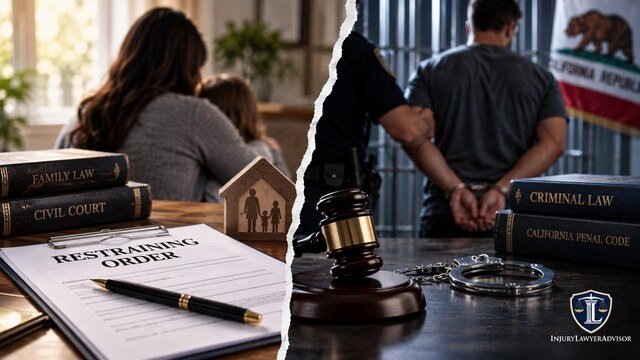
One of the most useful distinctions under California domestic violence law is that a restraining-order case and a criminal prosecution serve different purposes.
A criminal case is brought by the government. Prosecutors determine whether criminal charges will be filed, and conviction can lead to incarceration, probation, fines, treatment requirements, restitution, and other criminal penalties.
A DVRO case is a civil proceeding generally initiated by the person seeking protection. Its main purpose is protective relief rather than criminal punishment.
The two proceedings can exist at the same time. Statements filed in a civil restraining-order case may also create complications when a criminal investigation or prosecution is pending. California Courts specifically warns respondents that information included in DVRO response papers could potentially be used against them in a criminal case.
For that reason, someone facing both criminal charges and a restraining-order proceeding may need individualized legal advice before submitting written statements.
What Should Someone Do After Domestic Violence?
Anyone in immediate danger should call 911 or seek a safe location.
A person seeking protection can also contact a California court self-help center or a domestic violence organization for assistance with restraining-order forms and available resources. California Courts directs people seeking support to the National Domestic Violence Hotline at 1-800-799-SAFE (7233).
Preserving relevant evidence may also become important. Depending on the circumstances, useful records can include photographs, text messages, emails, call records, voicemails, medical records, police reports, witness information, and copies of prior court orders.
California law also provides qualifying domestic violence victims access to certain law-enforcement materials. Family Code Section 6228 requires agencies, upon a proper request, to provide specified records such as incident reports, related photographs, and 911 recordings within statutory timeframes, subject to the law’s requirements.
FAQ’s
Does domestic violence require physical injury in California?
No. California Family Code Section 6203 expressly provides that abuse is not limited to actual physical injury or assault. Threats, harassment, stalking, coercive control, and certain conduct that disturbs another person’s peace can qualify depending on the circumstances.
Can domestic violence laws apply to unmarried couples?
Yes. California law covers qualifying dating partners, current and former cohabitants, fiancé(e)s, and people who share a child, as well as spouses and former spouses.
How long can a California domestic violence restraining order last?
A restraining order issued after a hearing can generally last up to five years. A protected person may request renewal before it expires.
Can domestic violence affect child custody even without a criminal conviction?
Potentially, yes. Family Code Section 3044 centers on a court finding of domestic violence, and the statute provides multiple ways such a finding may be established. A criminal conviction is not the only possible basis.
Can someone possess a gun while subject to a domestic violence restraining order?
Generally, a person subject to a qualifying California protective order may not own, possess, purchase, or receive firearms or ammunition while the order is effective.
Is a domestic violence restraining order the same as a criminal conviction?
No. A DVRO is a civil protective order. A criminal conviction occurs through a separate criminal prosecution. The same underlying incident, however, may result in both civil and criminal proceedings.
Conclusion
California domestic violence laws protect people from a broad range of abusive conduct, not only physical violence. The law can cover threats, harassment, stalking, coercive control, sexual assault, financial control, and other behavior when it occurs within a qualifying domestic or intimate relationship.
The consequences can also extend beyond criminal penalties. Domestic violence allegations may lead to temporary or long-term restraining orders, firearm restrictions, mandatory treatment, and significant child custody consequences.
Because the correct legal response depends on the relationship, alleged conduct, evidence, existing court orders, and whether criminal proceedings are involved, anyone dealing with an active California domestic violence case should consider obtaining advice from a qualified California attorney or court self-help resource. This article provides general legal information and is not individualized legal advice.
