




A living trust is a legal arrangement that holds and manages assets during your lifetime and can transfer them to beneficiaries after your death. A revocable living trust can usually be changed, may help with incapacity planning, and can allow properly funded assets to avoid probate.
How Does a Living Trust Work?
A living trust creates a legal relationship among three important roles: the person creating the trust, the trustee who manages its property, and the beneficiaries who receive benefits from it.
The person creating the trust may be called the grantor, settlor, or trustor, depending on the terminology used in the document and state law. With a typical revocable living trust, that person often serves as the initial trustee and beneficiary as well. This means creating a trust does not necessarily require giving another person control of your property.
For example, suppose Maria creates the Maria Smith Revocable Living Trust and transfers her home and an investment account into it. Maria serves as trustee while she is capable of managing her affairs. She can generally buy, sell, invest, or use trust property according to the trust terms.
Maria also names her daughter as successor trustee. If Maria becomes unable to manage her financial affairs, the successor trustee can take over the assets covered by the trust according to its provisions. After Maria dies, the successor trustee can pay appropriate expenses and distribute or continue managing trust property for the beneficiaries named in the document.
The American Bar Association notes that this ability to manage property during life, during incapacity, and after death is an important distinction between a living trust and a will.
Revocable vs. Irrevocable Living Trusts
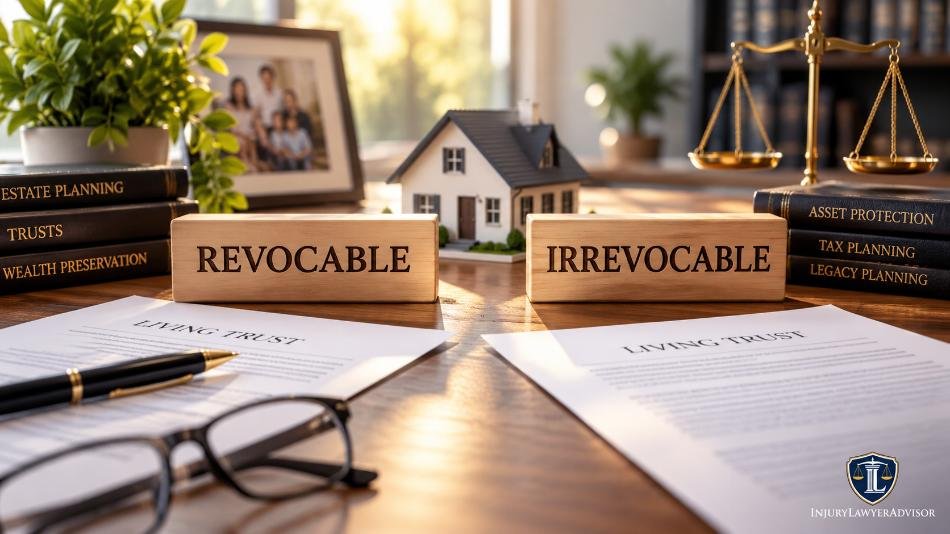

Not every living trust works the same way. “Living” simply means the trust is created during the creator’s lifetime. A living trust may be revocable or irrevocable.
| Feature | Revocable Living Trust | Irrevocable Living Trust |
| Can the creator usually change it? | Yes | Usually limited or no |
| Can the creator usually cancel it? | Yes | Generally no |
| Does the creator commonly retain control? | Yes | Control is generally more restricted |
| Common purpose | Probate avoidance, asset management, incapacity planning | Specialized estate, tax, or asset-protection planning |
| Income tax treatment | Generally treated as a grantor trust | Depends on the trust structure |
| Creditor protection for creator | Generally no | May be possible in certain structures and jurisdictions |
The IRS defines a revocable living trust as an arrangement created during an individual’s life that can be changed or ended during that individual’s lifetime. For federal income tax purposes, a revocable living trust is generally treated as a grantor trust, so its income is usually treated as belonging directly to the grantor.
Irrevocable trusts are substantially different. They can be useful for specialized planning, but giving up the ability to revoke a trust can have major legal, tax, and financial consequences. They should not be viewed simply as a more powerful version of a revocable trust.
What Is the Main Purpose of a Living Trust?
For many households, the primary reasons for creating a revocable living trust are probate avoidance, continuity of asset management, and control over how property is distributed.
Avoiding Probate for Trust Property
Probate is the court-supervised process used to administer certain property after someone dies. It can involve identifying assets, handling claims and debts, and transferring property to heirs or beneficiaries.
Property properly owned by a living trust can generally pass according to the trust without going through probate because the trust already holds title to the property. California Courts, for example, specifically identifies property held in a living trust as property that may transfer without formal probate procedures.
This distinction leads to one of the most important rules about living trusts: creating the document is not enough.
The trust must normally be funded.
If someone signs a trust but leaves a house, investment account, or other probate asset solely in their individual name, that asset may still be subject to probate. The trust cannot bypass probate for property it never owned or otherwise controlled.
Planning for Incapacity
A living trust can also establish who will manage trust property if the original trustee becomes unable to do so.
The trust document can name a successor trustee and define when that person receives authority. This may create a smoother transition for assets held in the trust if illness, injury, dementia, or another condition prevents the original trustee from managing financial matters.
A trust does not replace health-care directives or every form of financial power of attorney. Those documents can address decisions and property outside the trust.
Controlling Future Distributions
A trust does not have to require immediate distribution of everything after death. It can direct the trustee to continue holding property for beneficiaries under specified conditions.
For example, instead of giving a 19-year-old beneficiary $300,000 at once, a trust could provide funds for education and other needs while postponing larger distributions until later ages. The appropriate arrangement depends on state law, family circumstances, and the trust’s wording.
What Assets Can Go Into a Living Trust?
Common trust assets may include real estate, non-retirement investment accounts, certain bank accounts, business interests, and valuable personal property. The correct transfer method depends on the asset.
Real estate may require a new deed. A financial institution may require account ownership records to be changed. Closely held companies may have operating agreements, shareholder restrictions, or other rules governing transfers.
Some property should not simply be retitled without considering other consequences. Retirement accounts and life insurance, for example, often pass according to beneficiary designations. Jointly owned property and transfer-on-death arrangements may also pass outside probate under applicable law. A living trust does not automatically override those arrangements.
That is why trust funding should be treated as an asset-by-asset process rather than a single formality.
Living Trust vs. Will: Do You Need Both?


A living trust and a will overlap in some areas, but they perform different functions.
A will generally states how probate property should be distributed after death and can address matters a trust may not handle. A revocable living trust manages assets placed into it during life and can continue operating after incapacity or death.
Having a living trust therefore does not necessarily mean you should have no will.
Estate plans involving a trust frequently include a pour-over will, designed to direct certain remaining probate property toward the trust after death. Property passing through the will may still have to go through the applicable probate process before reaching the trust.
A will is also particularly important for parents of minor children because it can be used to nominate a guardian, subject to state law and court approval. The ABA specifically warns against assuming that creating a trust makes a will unnecessary.
The better question is therefore not “trust or will?” For many people, the documents work together as parts of the same estate plan.
Benefits and Limitations of a Living Trust
One of the strongest reasons to use a living trust is administrative continuity. The same legal arrangement can hold property while you are capable, provide a successor manager during incapacity, and govern the property after death.
Avoiding probate for funded assets can also reduce court involvement. A trust may offer greater privacy than a probate proceeding because its complete terms generally do not have to become part of a public probate file solely to transfer trust property. State procedures and litigation can affect that privacy.
A trust can also be useful when someone owns real estate in more than one state. Without appropriate planning, property in another state may potentially require an additional probate proceeding there. Trust ownership may help avoid that problem for qualifying property.
However, several popular claims about living trusts are misleading.
A standard revocable living trust generally does not protect your assets from your own creditors during your lifetime. It also does not automatically eliminate estate tax exposure. The ABA notes that because the creator retains the power to revoke or amend a standard revocable trust, its assets generally remain part of the creator’s estate for estate-tax purposes.
The IRS similarly states that assets of a revocable trust are included in the grantor’s gross estate for federal estate-tax purposes.
A trust also does not guarantee an immediate transfer after death. The successor trustee may still need to identify property, handle debts and expenses, address tax matters, communicate with beneficiaries, and complete other administrative duties.
How Do You Create a Living Trust?
Creating an effective trust involves more than downloading a document and signing it. The process normally includes:
- Identify your objectives. Determine whether your concerns include probate, incapacity, minor beneficiaries, property in multiple states, business ownership, or another planning issue.
- Inventory your assets. Review how homes, financial accounts, businesses, insurance policies, retirement accounts, and other significant assets are currently owned.
- Choose trustees. Decide who will manage the trust now and who should act as successor trustee if you become incapacitated or die.
- Choose beneficiaries and distribution terms. Specify who should receive the property and whether distributions should occur immediately or remain in trust.
- Prepare and execute the trust according to state law. Requirements and recommended provisions can differ by jurisdiction.
- Fund and maintain the trust. Transfer appropriate assets, coordinate beneficiary designations, and review the plan after major financial or family changes.
The final step is particularly easy to overlook. An unfunded or partially funded trust may fail to accomplish one of its primary goals.
How Much Does a Living Trust Cost?
There is no single nationwide price for creating a living trust. Costs depend on the state, attorney, complexity of the estate, number and type of assets, tax considerations, and whether the trust is part of a broader estate planning package.
The initial drafting cost should also be compared with the potential administrative benefits rather than considered alone. Someone with a modest estate consisting mostly of accounts that already transfer through beneficiary designations may receive less benefit from a trust than someone who owns multiple properties or has complicated distribution instructions.
There can also be ongoing work. Newly acquired assets may need to be coordinated with the trust, estate documents should be reviewed after major life events, and deeds or ownership records may require updates.
A cheap trust that is incorrectly drafted or never funded may provide less value than a simpler estate plan designed correctly for the owner’s situation.
Who Should Consider a Living Trust?
A living trust can be especially worth discussing with an estate planning attorney if you own real estate, own property in multiple states, want a structured plan for financial incapacity, have beneficiaries who should not receive assets outright, or want qualifying property to avoid probate.
It is not automatically necessary for everyone.
Probate rules differ dramatically among states, and some estates qualify for simplified transfer procedures. Assets with valid beneficiary designations, survivorship rights, or transfer-on-death arrangements may already avoid formal probate.
The decision should therefore depend on what you own, how it is titled, who should receive it, where the property is located, and what your state requires.
FAQ’s
Does a living trust avoid probate?
A properly funded living trust can generally keep property owned by the trust out of probate. Assets left outside the trust may still require probate unless another transfer mechanism applies.
Can I change my living trust?
If you have a revocable living trust and retain the appropriate powers, you can generally amend or revoke it during your lifetime while legally capable. Irrevocable trusts operate differently and can be much harder or sometimes impossible to change without specific legal procedures.
Do I lose control of my assets when I create a living trust?
Not necessarily. With a typical revocable living trust, the creator often serves as trustee and retains broad control over trust property during life.
Does a living trust protect my assets from creditors?
A standard revocable living trust generally does not shield assets from the creator’s creditors. Specialized irrevocable trusts may involve different rules, but protection depends heavily on trust structure and state law.
Does a living trust reduce taxes?
Creating a standard revocable living trust does not itself produce automatic federal income or estate-tax savings. The IRS generally treats the grantor as the owner of a revocable trust for income-tax purposes, and the assets generally remain part of the grantor’s gross estate.
What happens to a living trust when the creator dies?
A revocable trust commonly becomes irrevocable when the creator dies. The successor trustee then administers the trust according to its terms, which may include paying appropriate expenses and distributing assets or continuing to hold them for beneficiaries.
Conclusion
A living trust is a legal arrangement created during your lifetime that can hold and manage property for you and your beneficiaries. A revocable living trust typically lets you retain control while you are alive, provides a system for managing trust assets if you become incapacitated, and allows properly funded assets to pass without probate.
Its effectiveness depends heavily on proper drafting and funding. A living trust does not automatically eliminate taxes, defeat creditors, replace a will, or control property that never becomes subject to the trust.
Before creating one, review what you own, how each asset is titled, your state’s probate rules, your beneficiaries’ needs, and your incapacity-planning goals. For a significant or complex estate, an estate planning attorney can determine whether a trust provides a practical advantage and help ensure the documents and asset transfers actually work together.


